On this page
- Separate delivery, format, history, and freshness
- Which workload fits which delivery method?
- Understand freshness before comparing access speed
- When an API is the practical starting point
- When a daily feed is the practical starting point
- Plan the warehouse workflow, not just the download
- Use a hybrid architecture when the jobs differ
- Ask these questions before choosing a package
- Compare total operating cost
- Frequently asked questions
TL;DR Use an API for selective, on-demand retrieval, a daily feed for recurring broad analysis, and a hybrid approach when both workloads matter. Evaluate freshness, history, ingestion responsibilities, and total cost separately; API access does not mean every record updates instantly.
Choose a vehicle data API when your application needs selective, on-demand retrieval. Choose a recurring daily feed when your team repeatedly analyzes a broad dataset in its own environment. Consider both when operational features and analytical workloads have different access needs.
The choice is about how work gets done. An API does not automatically mean every record updates instantly, and CSV does not automatically mean a one-time, static download.
VinAudit positions its Market Listings API for filtered retrieval and its Total Market Feed for bulk workflows. The feed page specifies daily, 24-hour refreshes.
Separate delivery, format, history, and freshness
These are four purchasing decisions that are often bundled together.
| Term | What it describes |
|---|---|
| API | A programmatic interface through which an application requests data |
| Recurring daily feed | A scheduled delivery of datasets for repeated ingestion |
| CSV | A tabular file format; it does not specify an update schedule |
| Historical dataset | Data representing an earlier period, with a defined scope and depth |
| Hybrid architecture | A design using bulk delivery and selective API retrieval for different jobs |
A one-time download and a recurring feed can use the same file format while serving very different needs. With some providers, recurring feeds and historical backfills are contracted separately, so confirm how history is packaged for the feed you’re evaluating.
Which workload fits which delivery method?
Use this table as a starting point. The final choice depends on the available dataset, access terms, and operational requirements.
| Workload | Starting choice | What to verify |
|---|---|---|
| User-triggered vehicle lookup | API | Filters, response handling, usage limits |
| Search within a selected market | API | Query coverage and pagination |
| Repeated market-wide reporting | Daily feed | Scope, schedule, and successful ingestion |
| Joining broad market data with internal records | Daily feed | Identifiers, grain, and storage rights |
| Historical model development | Historical dataset plus an update plan | Backfill depth, observation dates, revisions |
| Product with search features and broad analytics | Hybrid | Definitions, identifiers, timing, and rights across both channels |
This is an architecture recommendation, not evidence that one channel is universally faster or cheaper. A small team may reasonably begin with a narrower workload and expand delivery options after measuring its actual needs.
Understand freshness before comparing access speed
Data freshness depends on more than how quickly a request returns. Ask when the source was observed, when the provider processed it, when it became available to you, and when your own application loaded or cached it.
For example, imagine a provider publishes a daily dataset, but your ingestion job fails. The provider may have delivered successfully while your dashboard still displays yesterday’s load. Conversely, repeated API requests may retrieve the same available record until its underlying information changes.
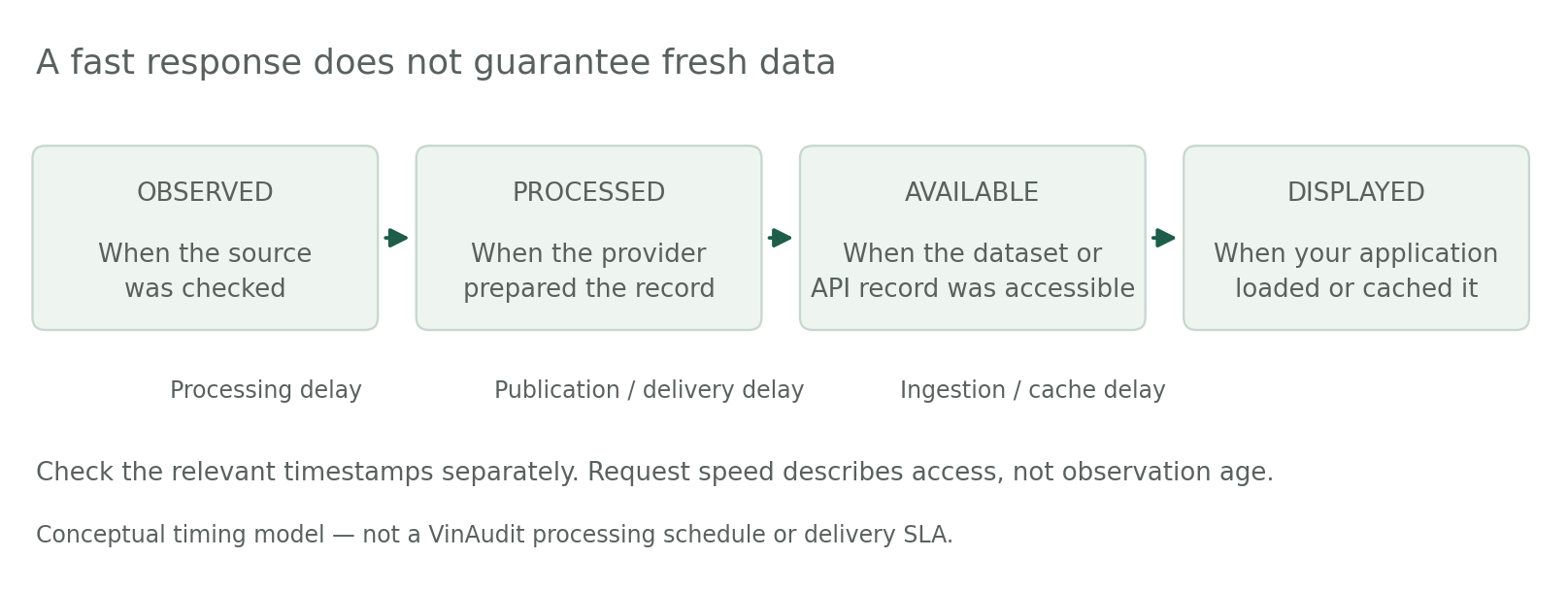
Conceptual timing model: observation, processing, availability, and application loading are separate stages. A quick query does not establish how recently the source was observed.
Track these times separately where the dataset makes them available:
Source observation or record-update time
Dataset publication or delivery time
Your ingestion or retrieval time
The time represented by the user-facing result
Daily-refreshed data is not real-time data. An on-demand interface is an access pattern, not a promise that the underlying record reflects an event immediately. Status labels carry their own time windows too: in VinAudit’s Market Listings API, a listing counts as active if it was listed within the last five days.
When an API is the practical starting point
An API fits workflows that can describe the records needed before retrieval: a particular VIN, an area, or a vehicle segment. Your application requests the relevant subset and handles the response within its own workflow.
VinAudit’s Market Listings documentation describes JSON/XML output, vehicle and geographic filters, and pagination. It also lets you include dropped listings through listing_status, with a history_days lookback that defaults to 30 days, and each listing carries a dated price_history. That gives the API some historical reach, but it doesn’t replace a defined historical dataset.
Before adoption, estimate request volume from user actions and background jobs. Include repeated searches, pages of results, and approved retries. The documentation caps paging at 10,000 records per query and sets key-specific limits on page size and search radius. Ask about usage limits and allowable storage rather than assuming an API subscription permits unrestricted extraction or indefinite caching.
A response can support a user interaction without becoming your permanent analytical store. If the team later needs repeated broad scans, evaluate bulk delivery instead of assuming that more API requests are the appropriate solution.
When a daily feed is the practical starting point
A daily feed fits recurring work over substantial portions of a dataset: regional inventory reporting, repeated joins, segment analysis, or preparation of analytical features.
VinAudit’s Total Market Feed page offers structured CSV/bulk datasets, market snapshots, configurable scope, and historical listing data. It also lists CSV/SFTP delivery. Confirm the actual transport, historical coverage, and schedule for the proposed package.
The operational advantage is control over analysis after a successful load. Your team can run its own queries repeatedly within the agreed usage terms. That control also brings responsibility for storage, data validation, access management, and reporting continuity.
Full snapshots and changes-only deliveries require different ingestion logic. The comparison below is general guidance; confirm which approach applies to your VinAudit package.
| Question | Full snapshot | Changes-only delivery |
|---|---|---|
| What arrives? | The defined dataset as of a delivery point | Updates since an agreed baseline or previous delivery |
| What does absence mean? | The record is absent from that snapshot; investigate scope before inferring a reason | No update may have been supplied; absence alone does not remove the record |
| What must your system do? | Validate completeness, then publish according to agreed replacement rules | Apply updates to the baseline and handle explicit removals as defined |
| What should you confirm? | Scope, completeness checks, corrections, and publication timing | Baseline, update keys, ordering, removals, and recovery after a missed delivery |
Plan the warehouse workflow, not just the download
The following is general implementation guidance. It does not describe a promised VinAudit delivery contract.
Receive and identify the batch. Record its delivery context and retain the received file according to your agreement.
Validate before publication. Check expected columns, parseability, types, required identifiers, and unusual row-count changes.
Load into staging. Keep a failed or incomplete batch from replacing the reporting dataset.
Apply the agreed update behavior. Append, replace, or merge according to the dataset’s defined semantics.
Publish and record success. Make the completed batch’s timing visible to downstream users.
Handle failures deliberately. Alert the owner and retry without duplicating an already accepted batch.
Platform documentation provides useful implementation details. BigQuery explains CSV schema and loading choices, including append and overwrite behavior. Snowflake documents validation and investigation of failed bulk loads. Use the documentation for your selected platform to implement these controls.
CSV also needs a data contract. Agree on encoding, quoting, null representation, date formats, numeric units, and the representation of multi-value fields. A successful download does not establish a successful interpretation.
Use a hybrid architecture when the jobs differ
Consider a marketplace with two needs: an internal team produces daily regional reports, while an application retrieves selected listings for a user’s search.
A possible design uses a daily warehouse load for reporting and an API for selective retrieval. This separates access patterns without assuming that the API’s underlying data is fresher.
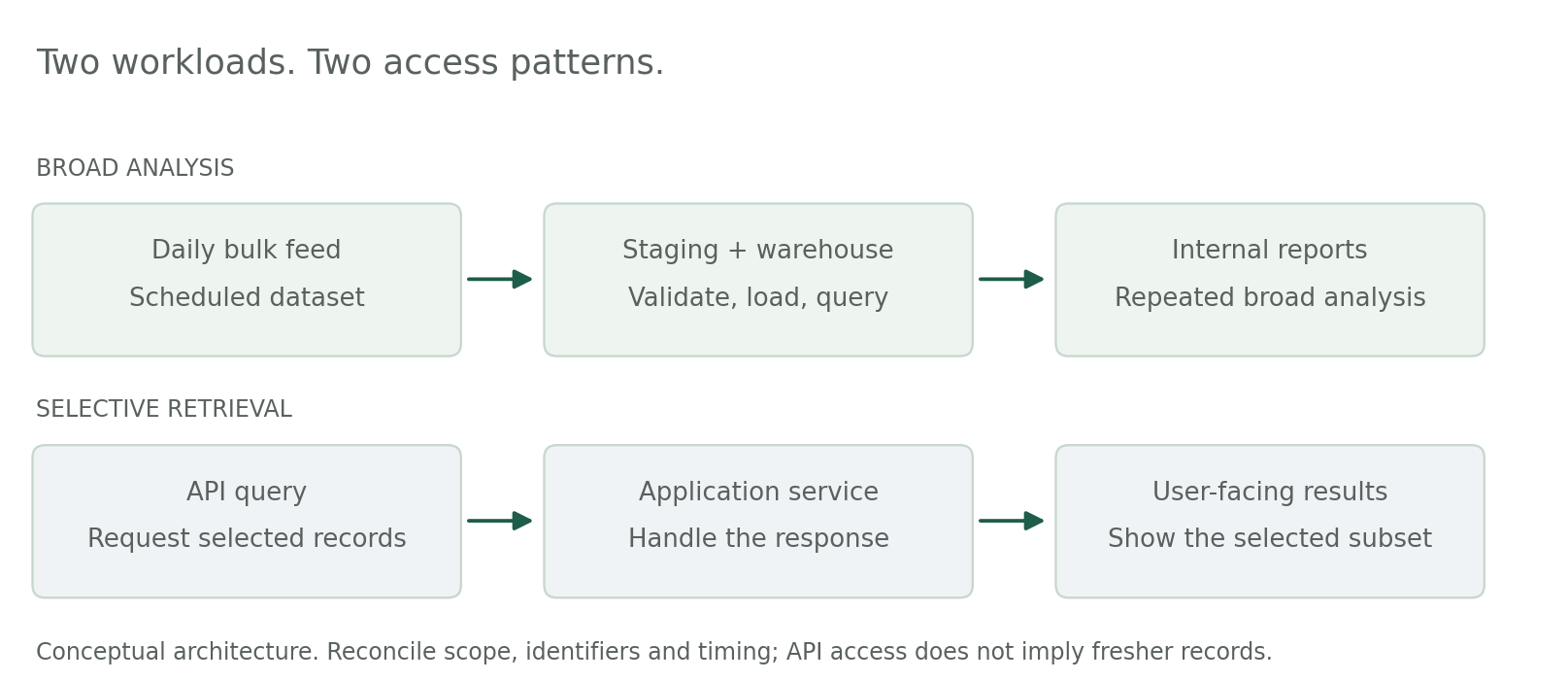
Conceptual hybrid architecture: use bulk data for broad reporting and API queries for selected application results. Reconcile scope and timing across both paths.
Before combining channels, reconcile identifiers, field definitions, included populations, and time coverage. If the warehouse and API return different totals, investigate the scopes and timing before concluding that either is wrong.
Historical work needs particular care. Keeping daily snapshots from today forward does not create observations from before collection began. A backfill can support earlier-period research only to the extent that the supplied historical dataset covers it.
Ask these questions before choosing a package
| Area | Question to settle |
|---|---|
| Scope | Which countries, segments, sources, and fields are included? |
| Grain | Does one row represent a vehicle, listing, seller offering, or observation? |
| Identity | How do listing identifiers and VINs relate across records and channels? |
| History | What period is available, and how are corrections and relistings represented? |
| Delivery | What schedule, time zone, transport, and missing-delivery process apply? |
| Change handling | Full snapshots or changes; how are removals and revisions signaled? |
| Schema | How are changes announced, tested, and introduced? |
| Rights | What storage, display, redistribution, and modeling uses are permitted? |
| Operations | Who owns failures, support, and recovery? |
| Cost | What are the access, ingestion, storage, compute, and maintenance costs? |
Do not deduplicate solely on VIN until you have defined the analysis unit. Several listing records may describe one vehicle, and collapsing them too early can discard information about sellers or observations. VinAudit’s feed includes VIN-level normalization, so you can analyze both raw listings and unified vehicle records.
Likewise, listing removal is an activity signal. It does not prove a sale or ownership change. Keep this distinction in reports regardless of delivery method.
Compare total operating cost
For an API, budget for the expected retrieval workload and the application work around it. For a feed, budget for access plus ingestion, storage, processing, monitoring, and maintenance. For a hybrid, include reconciliation work.
There is no defensible universal request threshold at which bulk becomes cheaper. Compare a representative workload under the actual commercial terms and measure how much operational work each option creates.
Review the Market Listings API and Total Market Feed against the same requirements. Request a sample with a defined scope, then confirm that your team can retrieve or ingest it, interpret it correctly, and keep its timing visible.
Frequently asked questions
Is a daily CSV feed a static database?
Each file represents a particular delivery. A recurring feed supplies successive datasets, which can be ingested automatically under the agreed schedule.
Is API data always real-time?
No. Request timing and underlying observation timing are separate. Check the provider’s refresh definitions and the record context.
Do I need both an API and a feed?
Use both when distinct workloads justify the added cost and maintenance. A single suitable delivery method may be enough.
Does a feed eliminate API limits?
A feed is a separate delivery arrangement with its own scope and terms. Evaluate it for bulk needs rather than treating it as unrestricted access.
Which option should a small team choose first?
Start with the smallest delivery arrangement that satisfies the actual workload and freshness requirement. Confirm operational ownership before adding a recurring ingestion pipeline.
How much history can I get?
It depends on the delivery. The Market Listings API can include dropped listings with a history_days lookback that defaults to 30 days, and each listing carries a dated price history. The Total Market Feed page describes historical listing data; confirm the depth for the package you’re evaluating.