On this page
TL;DR Read a vehicle valuation estimate alongside its price distribution, supporting count, variability, analysis period, and adjustments. Confirm the price context and input assumptions; a certainty indicator is not an accuracy guarantee, and an estimate is not a guaranteed selling price.
Product teams evaluating a vehicle market value API should judge two things: whether the number fits the intended pricing context, and whether the supporting information is sufficient for the decision being made.
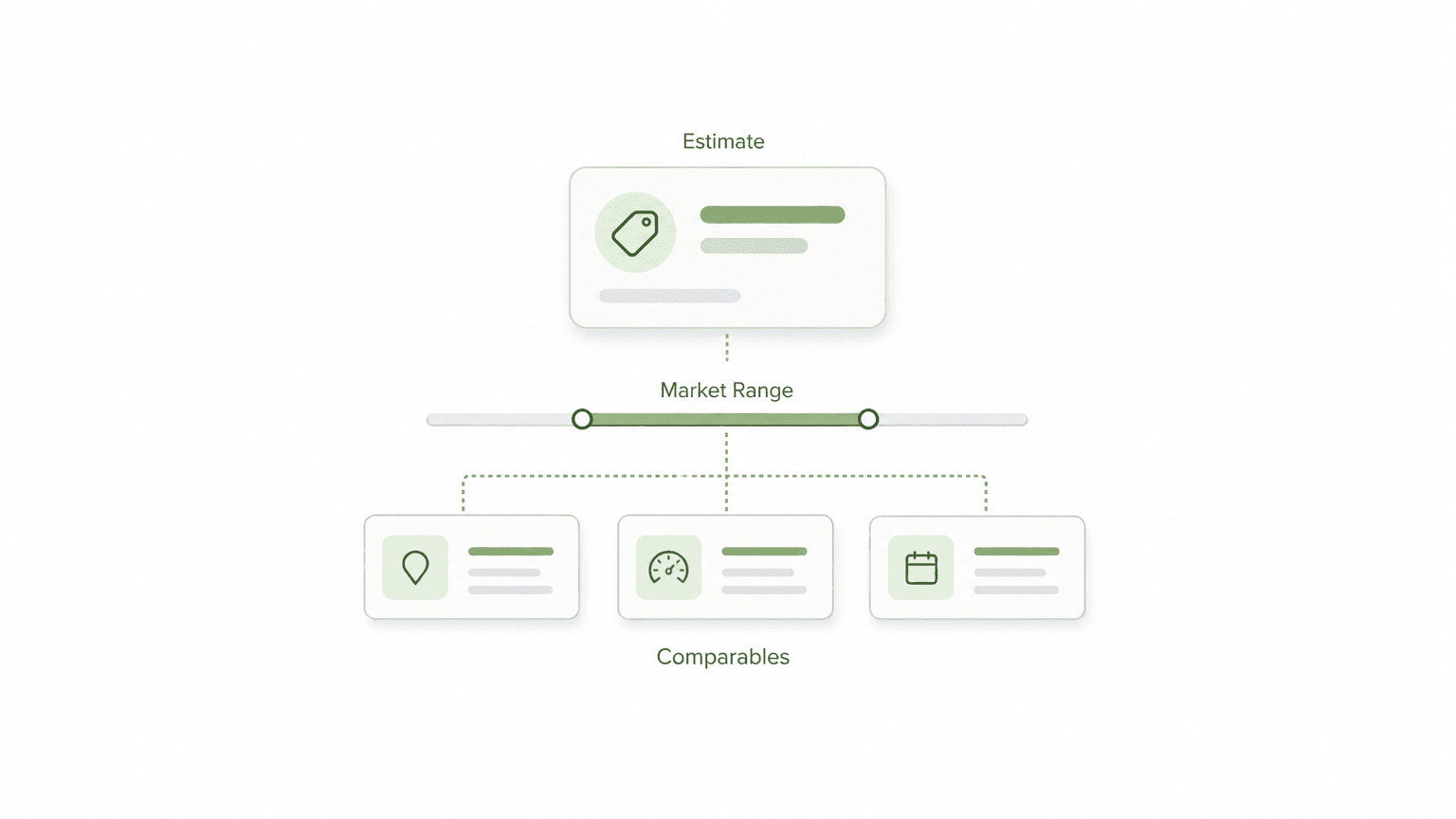
VinAudit’s Market Values API returns a statistical estimate along with the evidence behind it: a price distribution, the number of data points used, variability, a certainty indicator, the analysis period, and any adjustments applied. Before building on any valuation service, confirm what its underlying records represent—advertised prices, sales inferred from listing activity, or completed transactions—because that determines how the estimate should be labeled.
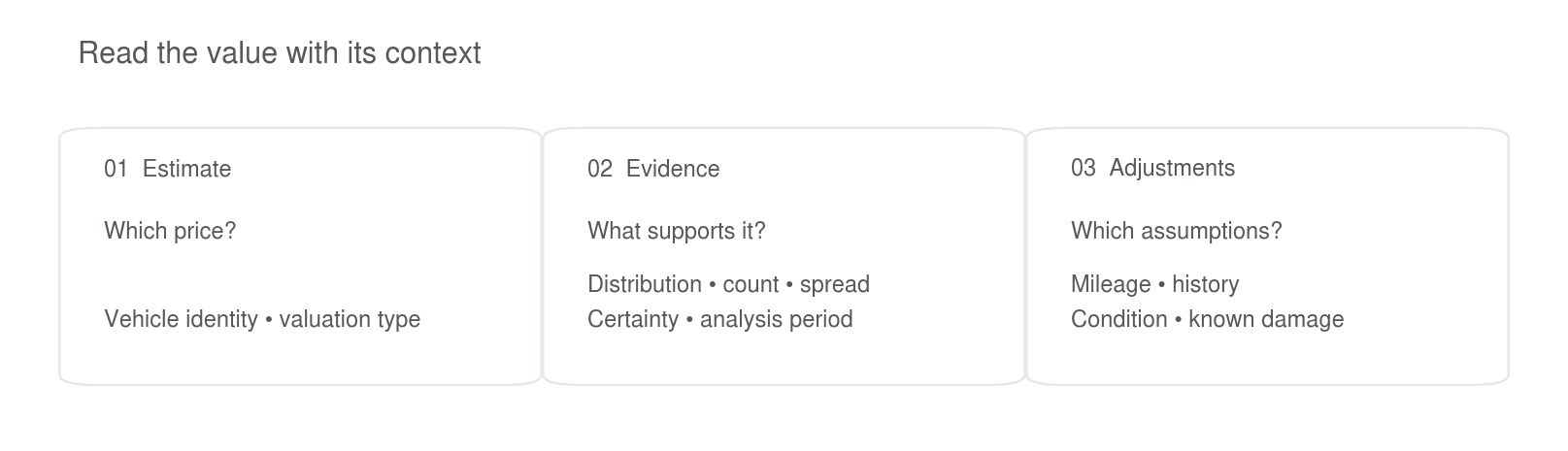
Read the estimate alongside its supporting evidence and adjustments.
First establish which price the product needs
“Vehicle value” can refer to several different things. Agree on the target before comparing providers or designing a pricing screen.
| Price concept | What it means for the reader |
|---|---|
| Asking price | What a seller advertises; negotiation may produce a different amount |
| Listing-derived estimate | A modeled reference informed by advertised market prices |
| Transaction price | The amount agreed in an actual purchase; its treatment of fees and other charges still matters |
| Retail estimate | A reference for the consumer-facing retail context |
| Trade-in or wholesale estimate | A reference for a different selling channel; label the channel clearly |
| Guaranteed or conditional offer | A separate commitment governed by the offer’s terms |
Automotive valuation sources distinguish asking-price references from purchase-price estimates. They also distinguish an appraisal estimate from a cash offer subject to separate conditions. Keep those categories separate when selecting data and explaining results.
A useful product label states the price context. “Estimated retail market value” gives a reader more information than “Your car is worth this.” An estimate alone does not establish a purchaser’s commitment, an insurer’s settlement amount, or a lender’s approved collateral value.
What the VinAudit response contains
The current Market Values documentation defines the following response fields.
| Field | Documented meaning |
|---|---|
success |
Whether market value data has been retrieved |
vin, id, vehicle |
Vehicle identity |
mileage |
Mileage used |
type |
Valuation context |
mean |
Estimated average market price |
prices.average, prices.below, prices.above |
Average, below-market, and above-market references |
prices.distribution |
Price buckets and counts |
count |
Data points used |
stdev |
Price standard deviation |
certainty |
Statistical confidence indicator |
period |
Underlying analysis date range |
adjustments |
Mileage, history, condition, and damage adjustments |
Read mean together with type. In the documented trade-in and wholesale examples, mean differs from prices.average, so don’t assume the nested price summary and distribution describe the same valuation type. Confirm before displaying them together.
Treat this as an evidence package. A headline estimate is easier to assess when its assumptions and supporting context remain visible.
A shortened retail response
This excerpt is taken from the documented retail response. It illustrates selected fields and is not a newly retrieved valuation. Other fields are omitted; the example dates are historical.
{
  "success": true,
  "vehicle": "2014 Toyota Corolla S",
  "type": "retail",
  "mean": 10880.54,
  "stdev": 2400,
  "count": 271,
  "mileage": 130163,
  "certainty": 99,
  "period": [
    "2025-08-17",
    "2025-10-10"
  ],
  "prices": {
    "average": 10880.54,
    "below": 8479.55,
    "above": 13281.53
  }
}
Read the estimate with its valuation type, supporting count, spread, and analysis dates. The certainty value is not an accuracy percentage.
Source: Market Values API documentation
How to interpret the evidence behind the estimate
Read spread alongside the central estimate
Two groups of vehicles can have a similar average while their prices are distributed very differently. A narrow cluster and a widely scattered group should not automatically produce the same product experience.
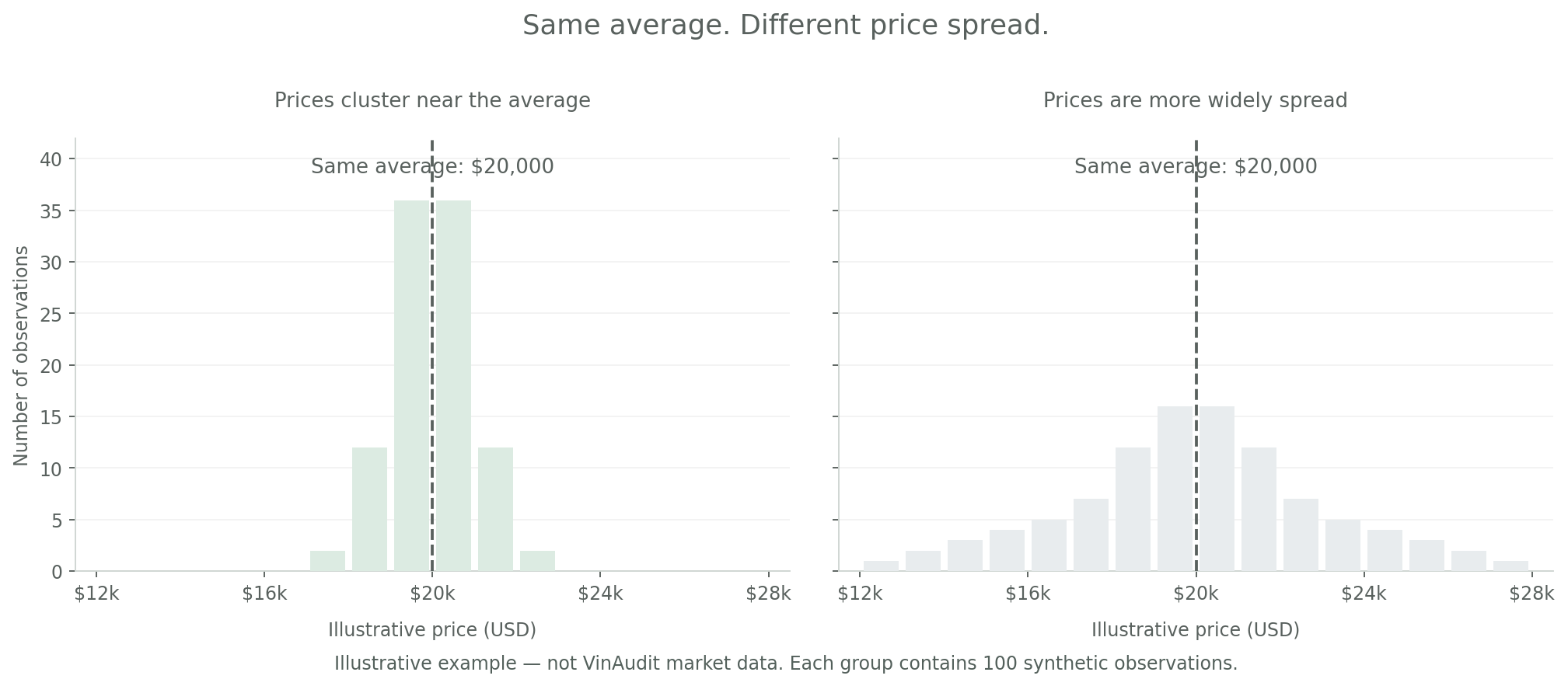
Illustrative example—not VinAudit market data. Both synthetic groups have an average price of $20,000, but their prices are distributed differently.
Standard deviation describes spread in the original units of the data. It can be affected by extreme observations, so a distribution view adds context that a single summary misses. This is general statistical guidance, rather than an explanation of VinAudit’s internal model.
For a review interface, let users inspect the price pattern before interpreting a vehicle as unusually expensive or inexpensive. For a consumer widget, a short explanation may be more useful than displaying every statistic.
Evaluate relevance as well as count
A larger sample does not, by itself, answer whether the evidence fits the vehicle and decision. Ask whether the comparison context matches the target trim, age, condition, geography, and selling channel.
Use a consistent evaluation set containing common vehicles, older models, unusual configurations, and damaged vehicles relevant to your audience. Review where the service supplies useful context and where your application should request more information. Any internal acceptance threshold should be tested for your workload rather than presented as a provider rule.
Keep variability separate from confidence
Price variability and uncertainty in an estimated mean are different statistical ideas. NIST’s explanation of confidence limits shows that uncertainty in a mean depends on sample size as well as variability, under the method’s assumptions.
Do not turn an indicator into a claim such as “99% accurate,” “99% chance of selling,” or “guaranteed within this range” without a definition that supports that interpretation. Likewise, do not relabel below/above reference values as a prediction interval simply because they form a range.
Key takeaway: Price spread is not the same as estimate confidence. Neither establishes a guaranteed selling price.
Keep the analysis window visible
The time represented by the supporting evidence matters to interpretation. A newly requested estimate and an analysis based on a longer historical window answer different timing questions.
For internal review, retain both the retrieval time and the returned analysis context. For user-facing displays, distinguish when the estimate was requested from the dates represented in the evidence. This helps prevent a recent screen refresh from implying that all observations are equally recent.
Inputs and adjustments establish the context
The following inputs establish the request context.
| Input | Purpose | Default or limitation |
|---|---|---|
| key | Authenticates the request | API key required |
| vin or id | Identifies the vehicle | Use a Decoder-selected id; do not construct it manually |
| mileage | Sets valuation mileage | Uses average mileage if omitted |
| period | Sets the analysis lookback | Maximum 365 days |
| type | Selects the valuation context | Retail default; confirm non-retail field relationships |
| condition | Applies condition context | average (default), like_new, not_great |
| known_damage | Supplies known damage context | Use documented values supported by your evidence |
| country | Selects the country | usa (default) or canada; only documented location input |
Confirm any local-market behavior with VinAudit before relying on it.
Use the best available vehicle information and record the assumptions made when information is missing. A valuation using assumed condition should not appear to be based on a physical inspection.
An adjustment is also different from evidence that an event did or did not occur. An empty history block or a zero adjustment should not become a “clean history” badge. Establish the relevant history and inspection evidence separately.
For mileage analysis, describe a result as a mileage-related price adjustment or difference. Calling it depreciation would require an analysis that isolates age, trim, condition, geography, and other relevant influences.
Turn valuation context into useful product behavior
The following are suggested design patterns, not claims about measured customer outcomes.
| Workflow | Useful presentation | Decision boundary |
|---|---|---|
| Consumer price guidance | Labeled estimate, assumptions, and explanatory context | Keep an estimate distinct from an offer |
| Dealer acquisition review | Vehicle details, supporting evidence, and inspection notes | Leave room for vehicle-specific appraisal judgment |
| Portfolio review | Consistent estimate context and cases needing attention | Use the signal to prioritize review within the organization’s process |
| Marketplace price comparison | Comparable selection criteria and advertised-price context | Avoid claiming that a below-reference ask proves a good purchase |
Plan what happens when identity is uncertain, inputs are incomplete, or the available evidence does not meet your own requirements. When there isn’t enough pricing data, the API returns success: false with a no_data code instead of an estimate. A request for more information or a review state can be a better experience than displaying an apparently precise number with missing context.
Evaluate the workflow before launch
Start with a representative sample and answer four questions:
Identity: Does the vehicle description match the intended configuration?
Context: Are the price channel, assumptions, and analysis timing appropriate?
Interpretation: Can reviewers understand the evidence without inventing meaning for the indicators?
Product behavior: Do incomplete or unsuitable results lead to a clear next step?
The VIN Decoder API can support vehicle identification, while the Market Listings API is a related option for listing research. An independently selected group of listings should not be presented as the valuation model’s exact underlying cohort.
Review the Market Values API and its documentation, then evaluate whether the returned evidence supports your intended decision—not simply whether a price appears on screen.
Frequently asked questions
Is a market value estimate a guaranteed selling price?
No. A modeled reference does not establish the final amount a buyer will pay. An offer or guarantee requires separate terms.
Does a price range tell me how accurate the estimate is?
A range needs a definition. Price spread, reference bands, confidence intervals, and prediction intervals answer different questions. Use the provider’s stated meaning.
Should I display every field to consumers?
Choose the information that helps the audience decide. Keep detailed context available for internal review and give consumers clear labels, assumptions, and explanations.
Can valuation data replace an inspection?
A price reference does not establish the physical condition of a particular vehicle. Design the workflow around the evidence required for that decision.
What does a certainty value of 99 mean?
VinAudit’s documentation describes certainty as a statistical confidence indicator. It isn’t defined as an accuracy rate or the probability that a vehicle sells at the estimate, so don’t present it that way. Read it alongside the count, spread, and analysis period.