On this page
- What does VIN monitoring mean here?
- Prepare a Portfolio That Can Be Matched Back to Contracts
- Submit the agreed CSV through SFTP
- Read the output as listing evidence
- Turn the Signal Into an Internal Review
- Make recurring checks repeatable
- What coverage limits should teams expect?
- Which VinAudit Product Fits Each Part of the Workflow?
- Frequently asked questions
TL;DR VinAudit’s VIN Monitoring Service compares portfolio contract dates with detected market listing activity through a CSV/SFTP batch workflow. Treat results as signals for documented review: a detected listing does not prove a sale or ownership change, and no detected activity does not establish that none occurred.
VinAudit’s VIN Monitoring Service compares portfolio contract dates with detected market listing activity through a CSV/SFTP batch workflow. It supports one-time and recurring reviews, with listing and seller details available in structured results.
A detected listing is a reason to review a record. It does not prove a completed sale, ownership transfer, fraud or contract violation. The business value comes from connecting the observation to the correct contract, checking its context and documenting the follow-up.
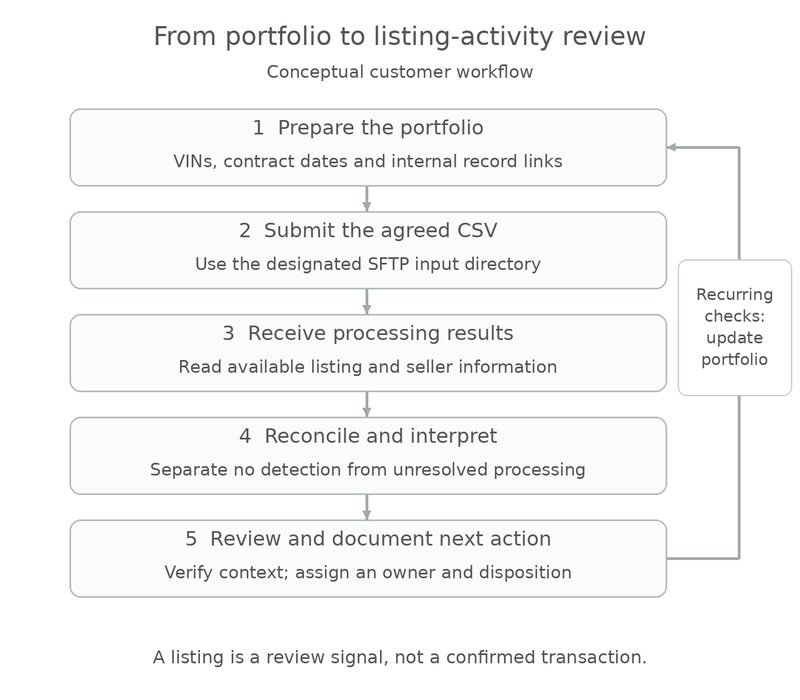
Figure 1. Conceptual customer workflow based on the public service description—not an internal-system diagram. Detected activity requires review.
What does VIN monitoring mean here?
VIN monitoring is not one universal product category. Before evaluating a service, establish which activity it monitors and which evidence it returns.
| Monitoring type | What it watches | Example | What it doesn’t establish |
|---|---|---|---|
| Listing-activity monitoring | A vehicle’s presence in covered advertisements | VinAudit VIN Monitoring Service (this guide) | A completed sale or ownership change |
| One-time vehicle-history check | Available history records at the time of a query | A requested vehicle-history report or query | Automatic future alerts or continuous observation |
| History-event monitoring | Newly received vehicle records | CARFAX VIN Alert lists title, registration, service, inspection, accident, import/export and lien records among its alert types | That the vehicle was advertised for sale |
| Title-change monitoring | Administrative title records | Vitu describes its VIN Tracking API as checking NMVTIS and NVS for title and ownership changes | Market listing activity |
| GPS or telematics tracking | Location or device observations | Device-based tracking services | Advertising or title activity |
A newly received record is a different signal from a newly observed advertisement, and a title-change capability shouldn’t be assumed from the word “monitoring” alone. Likewise, a seller’s address in a listing is not the vehicle’s verified current location.
This guide covers listing-activity monitoring only.
1. Prepare a Portfolio That Can Be Matched Back to Contracts
Start with the records your team needs to review, then preserve a reliable path from each vehicle to its internal contract or account. Cleaning the VIN list is only part of the job: an observation is difficult to act on if the reviewer cannot identify which business relationship it concerns.
Store VINs as text and compare suspect values with the source record. NHTSA describes the modern VIN as a 17-character identifier. Flag incomplete values, accidental spaces and transcription problems rather than guessing a correction. Older or exceptional identifiers should follow a documented exception process.
Define the business meaning of the contract date before exporting it. Issuance, activation and renewal dates may differ in your systems. Select the appropriate date for the review and record that choice internally; do not assume the service can resolve an ambiguous date on your behalf.
Also preserve relationships where one VIN appears under several contracts or dates. Removing duplicates from a vehicle list can be sensible, but silently dropping contract relationships can change which records receive attention.
These are preparation recommendations for your team. They are not an upload specification. Use the agreed file layout for column names, required fields, date format and duplicate handling, and keep internal account or customer information out of the submission unless it is required and approved.
2. Submit the agreed CSV through SFTP
VinAudit’s VIN Monitoring Service page describes the workflow: clients upload VIN portfolios with contract dates as CSV files to secure SFTP input directories, uploads automatically trigger processing, and results come back as standardized CSV output.
During onboarding, obtain the connection and file instructions for your account. Use your organization’s approved transfer process, verify the destination and limit credential access to the people or systems that need it.
Keep a submission record with the batch reference, submission time and expected portfolio scope. Preserve the source export so a later discrepancy can be traced to what was actually sent.
Before building a recurring process, establish how accepted, rejected and unprocessed records will be identified in the agreed delivery. A transferred file and a successfully reviewed portfolio are different checkpoints. Do not assume undocumented acknowledgement files, retry rules or processing times.
3. Read the output as listing evidence
According to the VIN Monitoring Service page, output files may include listing dates, vehicle descriptions, pricing, mileage, seller information and dealer contact details, and the service retrieves the latest available listing activity. The public service page does not specify a field-level output schema.
Check three things before deciding what the result means:
- Identity: Does the VIN match the intended vehicle and the correct contract relationship?
- Timing: What does the returned date represent, and how does it relate to the contract date?
- Context: What seller, vehicle and listing information is available, and is it sufficient to understand the observation?
A vehicle observed in an advertisement after a contract began may have been advertised before that contract. An observation date is not automatically the original advertisement date, transaction date or transfer date. Where the returned evidence does not resolve that distinction, leave it unresolved.
Likewise, a seller name or mileage value adds context without independently verifying possession, ownership or the vehicle’s current condition. Treat missing details as missing evidence.
4. Turn the Signal Into an Internal Review
VinAudit describes the comparison as a way to identify vehicles that may have been sold or traded in after contract issuance. Keep that qualifier: a detected listing flags a possible change for review, not a confirmed one.
Build a review queue that records what was observed, what was checked and who owns the next action. Keep the evidence separate from the business conclusion.
The following are suggested internal review states, not VinAudit response codes or returned status values.
| Finding | Suggested Review Action | What It Does Not Establish |
|---|---|---|
| Listing activity detected | Check VIN, date meaning, seller context and linked contract; assign a reviewer. | A completed sale or contract breach |
| Repeated observation | Attach it to the existing case when it concerns the same evidence; inspect material changes. | A second transaction |
| Identity or timing unclear | Hold the business conclusion and resolve the source-record or date issue. | A verified post-contract event |
| Processing or matching unresolved | Resolve missing output, unsuccessful processing or an uncertain match using the agreed delivery information; do not classify it as no detection. | A completed check with no detected activity |
| No detected listing activity | Check that the intended record was successfully processed and consider coverage limits. Record no detection only within that context. | That no advertising, sale or ownership change occurred |
A warranty team might check whether the listing relates to the correct contract and then follow its existing eligibility-review process. A lender might assess the observation alongside its account and collateral records. An insurer might reconcile it with policy information. These are illustrative review paths, not customer case studies or claims of results.
If the decision requires a confirmed sale or ownership change, seek evidence appropriate to that question. Do not update ownership records, cancel coverage or label activity fraudulent solely because a listing was detected. Record a reviewer’s conclusion separately from the original observation.
5. Make recurring checks repeatable
A recurring workflow needs a maintained portfolio and an owned review process. Agree a schedule appropriate to the service arrangement and your team’s ability to investigate the returns. Do not equate recurring checks with continuous or real-time tracking.
Between runs, update the portfolio for new, closed or corrected contracts. Keep enough internal history to understand why a record entered or left the submitted population.
Preserve the relationship between each submission, returned result and review case. Where a listing reappears in several runs, add meaningful updates to the existing case rather than repeatedly creating unrelated incidents. Keep observations from different sellers distinct until the reviewer understands their relationship.
Use the distinctions in the review-action table to reconcile each run. Keep unresolved processing or matching separate from a successfully processed record with no detected activity.
The review is operationally complete when each relevant finding has an owner, a documented disposition or next step, and an auditable link to the supporting records.
What coverage limits should teams expect?
Coverage defines which activity can become a signal. The VIN Monitoring Service page lists U.S. and Canada market coverage and notes that private sales aren’t always detected, because detection depends on visible market listing activity and available listing coverage.
No detected activity should therefore remain a limited finding: none was detected within the relevant coverage and processing context. It is not confirmation that the vehicle remained with the same owner or was never sold.
Timing also matters. The public page doesn’t publish a processing time or a recurring-check frequency, and a batch workflow isn’t an instant alert. A check can’t be more current than the listing observations behind it, and daily-refreshed market data is still not real-time.
Which VinAudit Product Fits Each Part of the Workflow?
Choose the product around the task and evidence you need:
- VIN Monitoring Service: portfolio review using the contract-date batch workflow described above.
- Market Listings API: targeted listing queries when your team needs to investigate covered vehicle records. Confirm query behavior in the listings documentation; do not assume its response schema is the monitoring output schema. Its documentation lets you include dropped listings, which it labels as no longer actively listed (likely sold), with a
history_dayslookback that defaults to 30 days. - Total Market Feed: broader daily bulk market datasets for teams maintaining their own analytical records and historical comparisons.
- Vehicle History API: a separate source of US vehicle-history records. Its documentation covers titles, brands and junk/salvage/insurance records, with lien, impound, export, theft and salvage-auction records available as add-ons.
A complementary history query can add relevant context. It does not make a listing signal a confirmed transaction, and it should not be assumed to supply every event or an automatic alert subscription.
Frequently asked questions
Does a detected listing prove that the vehicle was sold?
No. It records advertising-related evidence. A sale or ownership change needs separate corroboration.
Does this service monitor title or registration changes?
The publicly described workflow is listing-activity monitoring. Do not assume title-event or registration alerts are included; evaluate those requirements separately.
How should we choose a review schedule?
Balance the time sensitivity of the business decision with data freshness, the agreed service arrangement and the team’s capacity to follow up. More frequent checks do not make an observation more conclusive.
Should a monitoring result automatically change a contract?
Keep observation capture separate from contract decisions. Any downstream automation should preserve the evidence and follow the organization’s existing review and decision policy.
What should we confirm before a pilot?
Agree the input layout, date meaning, output sample, coverage, processing reconciliation, schedule and review owner. The pilot is useful when your team can match a result to a contract and document an appropriate next action.